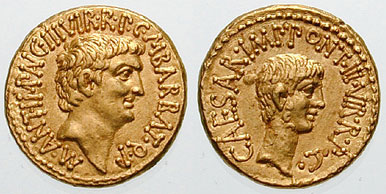
Actium is the place most of the history books considered to be the end of the Roman Civil War between Octavian and Mark Antony. It was a naval battle that Octavian and his masterful admiral, Agrippa, won. Antony and Cleopatra would escape to Egypt, but for all intents and purposes the battle has been considered an end point, with the Octavian creating the Roman Empire as we know it in the battle’s immediate aftermath. Even famed Roman historian, Cassius Dio, writing some 200 years later, considered Actium the end of the conflict between Octavian and Antony. However, in the moment, it certainly would not have felt this way to Octavian for reasons set forth below.

Though Antony and Cleopatra suffered an extraordinary defeat at Actium, they escaped with two critical things: their lives and their treasure. In Rome, loyalty of the legions was often tied to a person, rather than the state itself. Of course, a good way to earn this loyalty was to provide your soldiers with riches. Though escaping from a battle rather than relentlessly taking the offensive was viewed as anti-Roman, having wealth could serve as a counterbalance to this, particularly as Octavian had little wealth. To simply fund his campaign, Octavian had even needed to levy substantial taxes on the Italian people and was still struggling to pay his soldiers. This made his position precarious. Would Antony’s riches entice some of these potentially disgruntled soldiers away? It must have seemed a real possibility to Octavian.
Regarding wealth, Antony had escaped to Egypt and was largely supported by the Eastern half of the Roman state. The East was far more sophisticated and wealthy than the West. Simply overtaking Antony in the hierarchy in Rome and the rest of the Italian peninsula would not be enough for a man of Octavian’s ambition. He had debts to pay and also wanted to match or surpass the prestige of his adoptive father, Julius Caesar (who Antony was ironically a right hand man for). To do this, he needed all of the power consolidated to him, not split with a warring faction. Antony was cornered, but as Romans’ proved time and time again, they were dangerous after defeat. The Punic Wars were a great example of this, where Rome suffered shattering defeats that would break most civilizations, only to refuse to surrender, resulting in ultimate victory. Antony would have been brought up with knowledge of these histories, and would have perhaps had a strong influence in his behavior after Actium. Octavian at least, for his part, prepared accordingly.

One way Octavian tried to thwart any chance at momentum by Antony was to emphasize his own “Roman-ness” while highlighting how Antony had been corrupted by Cleopatra and the soft, decadent living in the East. To this bit of propaganda Octavian turned his eyes towards a massive construction project – his mausoleum. Though he was only in his 30’s, the point was simple – he was a Roman through and through. His mausoleum was to be built just outside the walls of Rome while rumor had it that Antony planned to be buried in Alexandria, land of the Ptolemies and Cleopatra. This was a politically calculated move to keep the people of Rome on his side. Roman pride was a reality, and their society was often xenophobic towards outsiders like Cleopatra.
To further his magnanimity and grow his personal brand, Octavian would focus not only on maintaining allies, but also on persuading former enemies to join him. While he didn’t issue widespread pardons, he was no longer the ruthless killer he was earlier in life when he carried out what are known as the proscriptions; lists of political enemies to executed. Some notable allies of Antony were spared, while others were executed to emphasize that Octavian was in charge. Another way he earned respect of the communities of the Eastern provinces was through his treatment of the governors. He decided to execute lesser provincial governors while pardoning the more powerful ones, which showed strength without completely annihilating functioning power structures in the region. He would even travel to Athens, a former stronghold for Antony to sway hearts and minds by showing clemency and even distributing his army’s leftover grain.
Octavian was squeezing Antony from every direction after Actium. Actium was a major victory, but Octavian clearly appreciated there was still work to do in its wake. He squeezed the figurative life out of Antony through post-battle politics as just as much as during the Actium Campaign itself. Antony would eventually give up hope and famously commit suicide, leading to Octavian becoming the first proper emperor of Rome. He would in time be known as the Divine Augustus, and the history books would mark Actium as the point of this transition, forgetting the other critical decisions Octavian had to make in the interim between Actium and Antony’s death.
Sources
The War That Made the Roman Empire: Antony, Cleopatra, and Octavian at Actium by Barry Strauss
Classical Numismatic Group. Mark Antony and Octavian. 41 BC. AV Aureus (7.95 gm). Mint moving with Mark Antony. M. Barbatius Pollio, moneyer. M ANT IMP AVG III VIR R P C M BARBAT Q P, bare head of Antony right / CAESAR IMP PONT III VIR R P C, bare head of Octavian right. Crawford 517/1a; Sear, CRI 242; R. Newman, “A Dialogue of Power in the Coinage of Antony and Octavian,” ANSAJN 2 (1990), 41.1; Sydenham 1180; BMCRR (East) 98; Bahrfeldt 77. Near EF, Very rare. Retrieved from https://upload.wikimedia.org/wikipedia/commons/8/8b/Antony_with_Octavian_aureus.jpg
Laureys Castro. The Battle of Actium, 2 September31 BC. 1672. https://commons.m.wikimedia.org/wiki/File:Castro_Battle_of_Actium.jpg#mw-jump-to-license
 Seven Hills History